Wednesday, January 23, 2013

BAM - Periodic Motion

Here is a brief video giving some guidance about the B assignment for periodic motion, in particular question 3.
   
Although this is a repost from my twitter stream, it illustrates the difference in period between pendulums in a beautiful way.
This professor helps to explain resonance and then gives a wonderful simple demonstration. He does some calculation practice for pendulums first as well. Note that in his calculations he is solving for FREQUENCY instead of PERIOD. This means that his formula is flipped upside down compared to ours. The demo he uses is a great illustration of resonance!
Behold the power of resonance! This is video of the Tacoma-Narrows bridge from the 1940's. Every object (pendulum, rocking chair, slinky, even bridge!) has a natural frequency, or rate at which it prefers to vibrate. If you help push it just right (resonance) you can get an effect like this.

Thursday, January 10, 2013

Roller Coaster Design


These three videos were created by a mechanical engineer working with the Skate Park simulation to help demonstrate some of the features that might be helpful for your design.

Design Help


Analysis Help


Incorporation of Friction Help

Monday, January 7, 2013

Niagara Falls

Over Christmas break Mrs. Quinn and I went on a road trip that took us into Canada and by Niagara Falls. I have never been before and was blown away by the magnitude of it all. Here is a picture I took from the room that we stayed at:
To the far left are the American falls and to the right is just a small portion of Horseshoe Falls on the Canadian side. I had seen them in pictures before but never up close. Horseshoe Falls in massive, unbelievably massive. Here is a short video of Mrs. Quinn and I standing right by the edge on December 26th.

We eventually made our way down behind the falls into a small tunnel that had posters talking about some of the details about how the falls had changed over time, famous visitors, and how much water actually goes over each minute. I took these two pictures for you guys because they have interesting information about the falls:
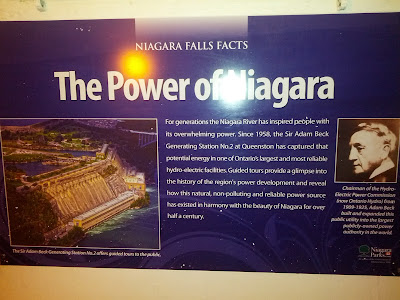
 It seems that over a century ago other visitors to the falls realized that not only were the falls beautiful to look at, but they were incredibly powerful. They developed ways to take energy from the falls and use it to power local towns. In fact, when I was there a new tunnel was being built to make the power plant even better and more efficient. In total 750,000 gallons of water go over the falls every second! 1 gallon is 0.0037854 cubic meters and 1 cubic meter of water is 1000 kg. With that information could you determine how powerful the falls are? Since there is a restriction as to how much water could be generated for power, what is the maximum amount of power that is actually generated? For comparison sake the maximum output of an 18-wheeler is 450 kW.

Niagara Falls is famous for daredevils going over in barrels. What I found out when I was there is that the first person to ever attempt/survive this feat was a woman name Anne Taylor, pictured below. I was also amazed to find out that she 63 when she made the attempt!
 Based on the height of the falls, can you determine how fast she must have been moving when she landed? Anne survived,but many others have not been so fortunate. In fact, since 1850 an estimated 5,000 bodies have been found at the bottom of the falls. The falls are another great example of the power, beauty, and potential danger of the natural world.

Wednesday, December 19, 2012

Ronnie Coleman

Ronnie Coleman is an 8-time Mr. Olympia, so he knows a thing or two about work and power. I was fortunate enough to meet Mr. Coleman and got to record this short interview.

Monday, November 26, 2012

Comets, Asteroids, Meteors, Oh My!

We use these terms somewhat interchangeably but, like most words, they each have a particular and somewhat different meaning. This may be worth learning about since we often have encounters with these objects as they travel through and around our solar system.Some of these encounters would not be so fun... just ask the dinosaurs.

On the other hand, some are very welcome and have an important place in culture. For instance, the famous Halley comet travels past us every 76 years and its passing has been a celebrated event by the people of Earth since the year 240 BCE.
Asteroids may not be as pretty, but are certainly worth looking out for. In fact, asteroid DA14 is due to pass by Earth on February 15th 2013 so close to the planet that it will actually be closer than our orbiting satellites.
Meteors may be the most important term for us to be familiar with. Here is an example of the effect a meteor can have on us. This is the Barringer Meteor Crater in Arizona which is about a mile in diameter and was formed by a meteor only about 150 ft wide.

See what you can find out about asteroids, comets, meteors, etc. Post a comment that describes their differences, warns of a future NEO (Near Earth Object) that we should worry about, details interesting information, or asks a question for which you can't find an answer.

Thursday, November 15, 2012

Tyson, The Universe, and Black Holes

Neil deGrasse Tyson is the director of the Hayden Planetarium and an astrophysicist. He is also funny, eloquent, and entertaining. Here is a list of 10 things we should all know about the universe that Tyson likes to talk about. Below are two videos. In the first Tyson answers a question from a 2nd grader: "What would happen if two black holes collided?" Below that is another video describing falling into a black hole. Tyson is brilliant and funny, watch the clips on youtube so that you can check out some of his related talks. Lastly, there is another Symphony of Science video called "Onward to the Edge" which is my favorite. If you can't take Tyson talking then listen to him sing with autotune!


Monday, November 12, 2012

We Are Stardust

We are all star dust, literally. You are a star! So am I, so is everyone else and everything you see. We all came from stars. They were the furnaces that produced the ingredients of life and everything else on Earth. Here is how:

Now to put a perspective on how big these furnaces are:
 
And lastly, for some light entertainment!

What have you found out about stars that is interesting? Where do they come from? How long to they last? What happens when they die? What is going to happen to our sun?

By the way, if you want to see some incredible pictures of our universe/space/etc check out NASA's Astronomy Picture of the Day.